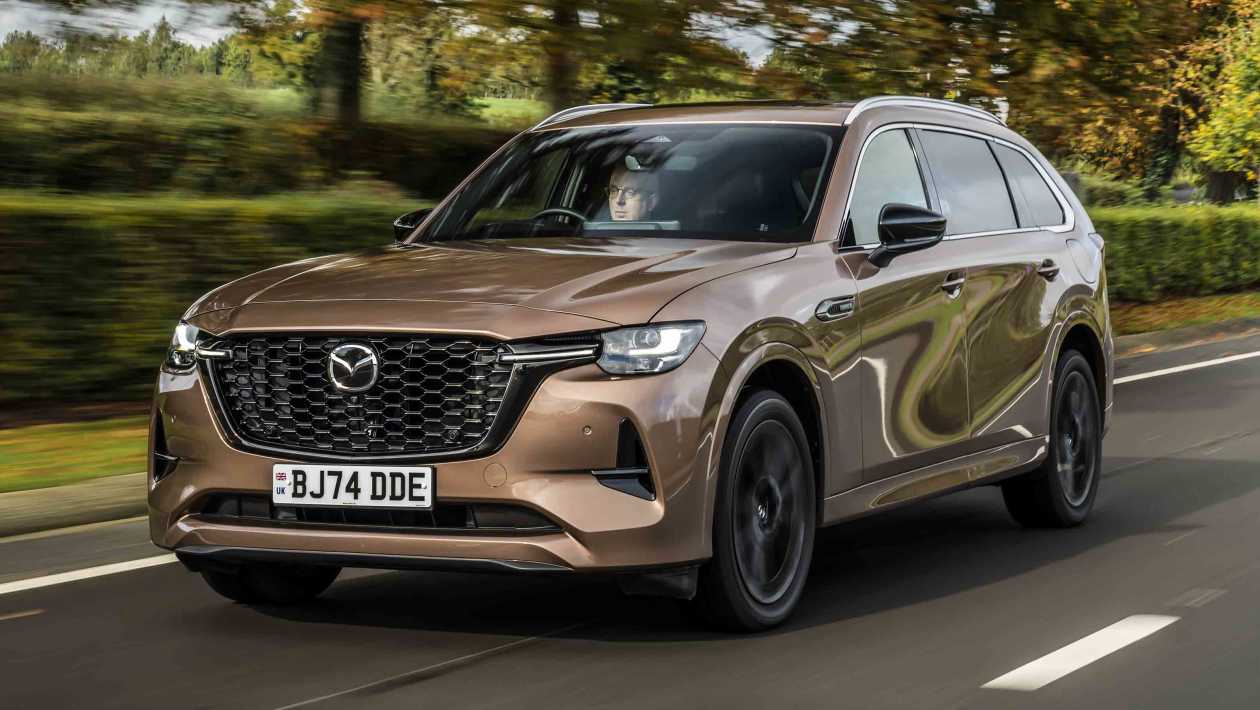
Unlike some seven-seat SUVs, there’s more than enough headroom and legroom in the rearmost seats for even six-feet tall adults to climb back there. We noticed that the third-row seats are shallow, however, which meant our legs were slightly raised from the seat bases, but it’s a minor gripe. Few SUVs beat the CX-80 for sheer passenger space and It is impressive that Mazda has been able to keep the seven seats in plug-in hybrid versions, which need to accommodate a large battery – something that can’t be said of the Skoda Kodiaq.
Boot space
There’s 258 litres of boot capacity available with all the CX-80’s seats in place, and that grows to 687 litres when the rearmost seats are folded flat – a process which is quick and simple to do by pulling straps on the backs of both. When all but the driver and front passenger seats are down, the CX-80 can carry up to 1,221 litres of cargo, or 1,971 litres if you load it right to the ceiling.
The boot opening is wide with no loading lip and there’s space under the floor for your charging cable in the plug-in hybrid. We did find that the powered tailgate didn’t open very high on our test cars, however, causing taller members of the team to bash their heads on more than one occasion.
Towing
Mazda is keen to highlight the CX-80’s 2,500kg maximum towing capacity, which applies to both diesel and plug-in hybrid models. The car also features a ‘Trailer Hitch View’ for its camera system, to make it easy for the driver to attach a trailer when they’re on their own, while a dedicated Towing drive mode takes into account the additional weight of a trailer and optimises the AWD system to improve straight-line stability. A retractable tow bar is a £980 option.
The CX-80 has a top five-star Euro NCAP rating and a comprehensive suite of safety assistance technology as standard
Pros |
|
Cons |
|
Safety experts Euro NCAP awarded the Mazda CX-80 the maximum five-star rating after crash testing it in 2024. The CX-80 scored higher than the Hyundai Santa Fe and Skoda Kodiaq in the adult occupant and vulnerable road user categories, and matched the Santa Fe in the child occupant and safety assistance technology categories.