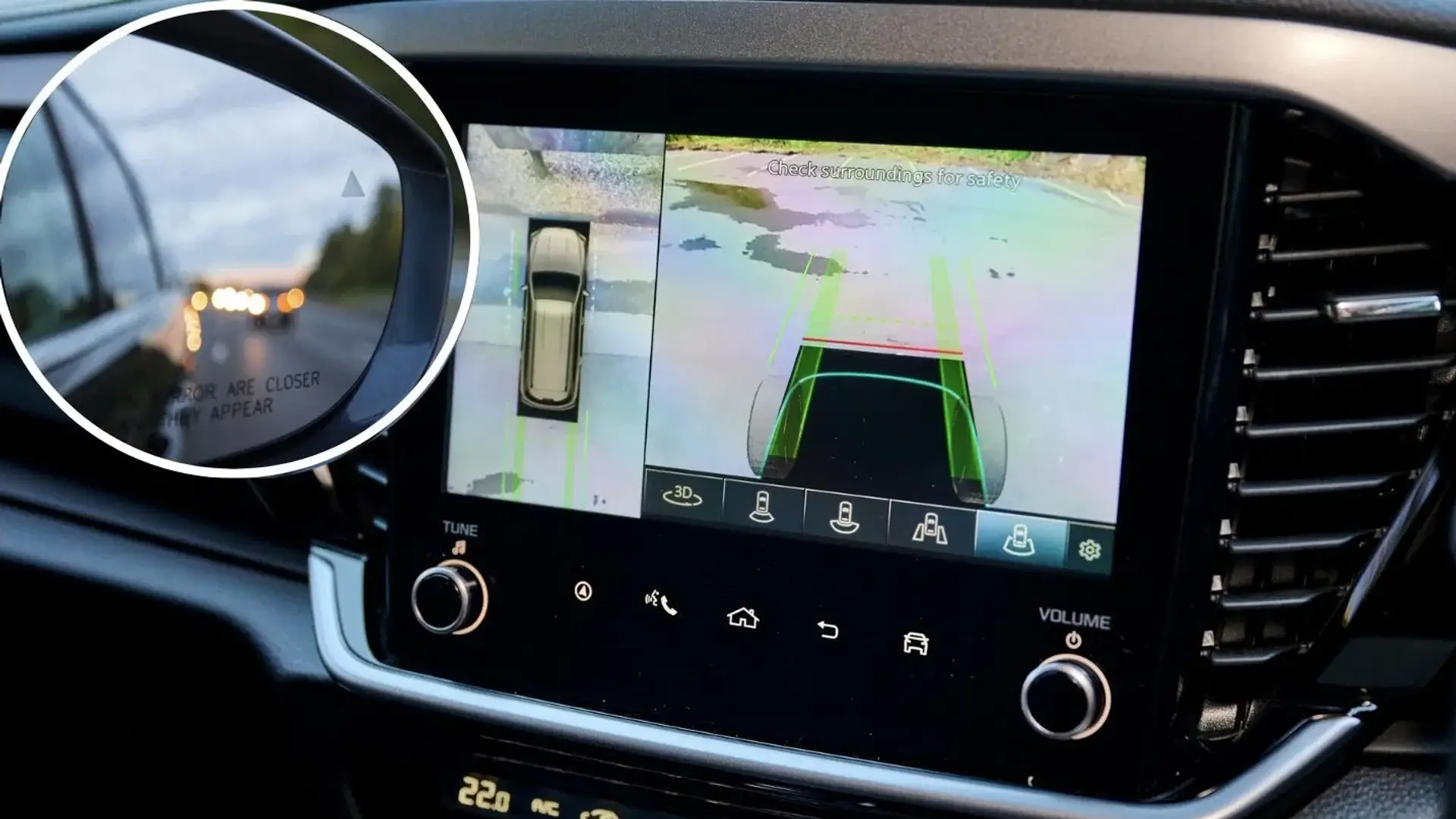
While parking cameras have become ubiquitous in modern cars, these highly advanced sensors still have blind spots.

To those of us with a few miles on the odo’, it really doesn’t seem that long ago that parking sensors weren’t around, and you had to rely on the analogue version.
That is, your mirrors, your own spatial awareness, and the unmistakable sound of a bumper meeting something solid.
RELATED: Is it better to reverse into a parking space? Experts weigh in
All were required to confidently park your vehicle. On the one hand, it kept many a panel beater in business. On the other, it made you much more adept at slow-speed manoeuvres.
These days, the advent of parking sensors and their continued evolution have made things a lot easier. Just keep backing up until that beep becomes a whine and you’re golden.
However, parking sensors are not infallible. If anything, they’ve made us a little too complacent when it comes to avoiding things like bollards or that concrete pylon that leapt up out of nowhere.
Blind spots very much still exist and indirectly contribute to many a minor fender-bender. Yep, even in the latest vehicles that have a chime to tell you when your coffee is at optimum drinking temperature and another for when you should really give your mum a call. It’s been two weeks, and she’s probably worried sick.
We thought it was high time for a quick refresher course on your vehicle’s hidden surprises, and how you can use a combination of new tech and good old-fashioned driver skill to prevent your car’s panels from looking like an old chip packet.

Ultrasonic vs 360-camera systems: Understanding their unique blind spots
Most modern vehicles use a combination of ultrasonic sensors and cameras for their parking systems and blind-spot detection, and while they’re very good, neither is totally foolproof.
Ultrasonic sensors utilise sound waves in a conical field to detect approaching objects. They have a few limitations.
The main one is that they’re not great at detecting stuff that’s coming at you fast, which isn’t such a big deal when parking, but with kids around or someone else driving forward into the spot you’re currently backing into… You get the picture.
They also have a limited zone of detection where they cannot see much beyond their narrow range (~0–5m usually), and even when things are extremely close (under 500mm) they can often exhibit a blind zone. Not ideal when you’re sneaking your huge ute into a “small car only” spot.
The 360-degree cameras use a series of lenses around the vehicle to stitch together a bird’s-eye view of the car, enabling you to gamify your parking experience and Tetris your car into its spot.
But to provide this top-down view, the software has to stitch several images into one, and depending on the specific system, things like poles or kerbs can get lost in that process – most commonly at the corners of the vehicle and sometimes in the area close to and directly adjacent to the sides.

The common objects your sensors cannot see
As you can imagine, the things your eyes can have trouble picking up are the same things your sensors and cameras do too.
We’re talking thin poles, low kerbs, and even more general terrain features, like steep angles, that can bring things unstuck.
As is probably becoming obvious, relying solely on your onboard tech to see every single hazard is not what you’d call safe driving. You need to use your mirrors, and probably most importantly your eyes as well.
Why heavy rain, ice or even dirt can make sensors useless
And that’s not even taking into account the fact that sensors and cameras need to have nothing obstructing them in order to work.
One of the oldest mechanic tricks in the book is to clean them when a customer comes in complaining their parking sensors don’t work, then charge you a couple of hundred bucks for the effort (of course, not all mechanics would do this, just the dodgy ones).
But just like you can’t take a nice photo with your phone’s camera if the lens is covered in gunk, your car’s cameras and parking sensors can’t do their job either. Basically, if you rely heavily on these devices, it’s a good idea to wash your car regularly.
For 4×4 owners, keep in mind that sensors are often required to be mounted in plastic, not metal. If you’re planning to fit a steel or alloy bullbar, have a chat with your installer about keeping your electrics happy before pulling the trigger.
The ultimate method: Combining sensors, cameras and mirrors to park perfectly
As we’ve alluded, sensors and cameras are a tool, not a silver bullet. They absolutely can and should be put to use when parking, but you should also still be using your mirrors and your wits to park effectively.
And hey, if you’re not that good at it, there’s zero shame in that. Next time you can’t find anything to watch on Netflix, head out and practice. You’ll be backing in with perfect positioning every time in no time.
The post The worrying blind spots your car’s parking sensors can’t see appeared first on Drive.