The Ioniq 9 is capable of taking on a fast charge when you find public chargers quick enough, but it’s also able to top up smaller devices at a rapid rate, too. There are no fewer than seven USB-C chargers on board, catering for passengers in all three rows. These can operate at up to an impressively rapid 100 Watts, although you’ll need a thicker charging cable to take full advantage of this.
There’s also a wireless smartphone charger on the centre console. While it has a rubber pad to improve grip between phone and charger, it’s fairly small, so even during normal acceleration, braking and cornering, we found that our phone would move around enough that it would stop charging until it was repositioned.
Another carryover from Ioniqs 5 and 6 is vehicle-to-load capability, so that you can power accessories from the car’s drive battery or even send power back to the grid.
As with several other Hyundai EVs, the Ioniq 9 is available with digital side mirrors as a £1,000 option, and they replace the traditional mirrors with cameras mounted on stalks. While Hyundai’s tech works better than some of the other types we’ve tried, we don’t see enough benefit to stump up the extra cash – especially since they still sit proud enough from the bodywork for them to be susceptible to knocks. The digital rear-view mirror comes in handy when the back two rows of seats are loaded with occupants, though. – Alex Ingram, Chief reviewer
Large exterior dimensions translate into a vast cabin with boot space to spare
Pros |
|
Cons |
|
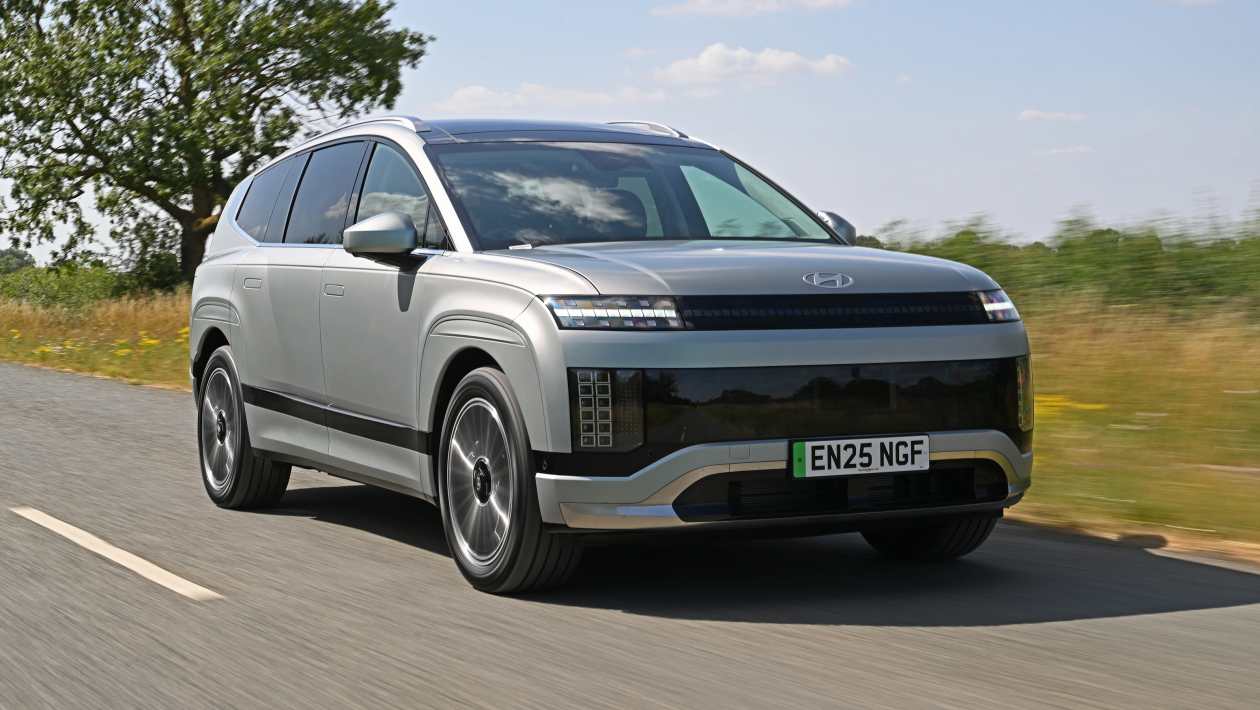
At more than five metres long, and almost 1.8 metres tall, the Ioniq 9 is vast on the outside, but as long as you have the space to park it, occupants inside reap the benefits with acres of room to stretch into.
Dimensions and size
As you’d expect, the Ioniq 9 and Kia EV9 are similar in size, and take Hyundai/Kia’s E-GMP electric car platform to its maximum size. A five-metre length is the same as a Range Rover, and the Ioniq 9 is larger overall than most other seven-seat SUVs.
| Dimensions comparison | |||
| Model | Hyundai Ioniq 9 | Kia EV9 | Peugeot e-5008 |
| Length | 5,060mm | 5,010mm | 4,791mm |
| Width | 1,980mm | 1,980mm | 1,895mm |
| Height | 1,790mm | 1,755mm | 1,694mm |
| Wheelbase | 3,130mm | 3,100mm | 2,901mm |
| Boot space | 338-2,419 litres | 333-2,318 litres | 259-1,815 litres |
Seats & passenger space
The Ioniq 9’s tall body allows the driver to have a commanding view of the road ahead. The driving position is high, but while the square, near-horizontal bonnet makes it easy to see where the car ends, it also creates quite a blind spot ahead of the car. Fortunately 360-degree cameras are available, so it’s still possible to squeeze into tight spots. The steering wheel itself is very large, which can make it feel a little clumsy to use at times