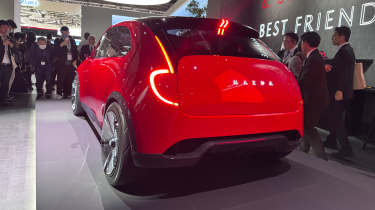
The rear end is a total departure, with two-piece lighting that forms a small semi-circle, and a vertical stripe up towards the rear glass. The tailgate then sits proud of this in an unusual fashion, giving the rear end a unique look within the Mazda range. Once again, this will be toned down for the production car, but it is still a very interesting and distinctive feature.
The cabin is just as dramatic, with a bold use of body colour on the doors and centre console. There’s only one digital dial behind the steering wheel for the driver, with a second, smartphone-like display mounted next to it. Curiously, the concept has a rev-counter, physical gearlever and paddle-shifters behind the steering wheel, confirming that this will be a combustion-powered model.
The new model will use a flexible small car architecture currently being developed, underpinned by a transversely-mounted ICE engine. As is the class norm, this will power the front wheels. However, it’s still far too early to guess whether manual and automatic transmissions will be available.
The petrol engines could be Mazda’s next-generation Skyactiv-Z units, and will be available with and without hybrid assistance. Unlike the current model, which is a rebadged Toyota Yaris, the new hybrid Mazda 2 will be pure Mazda. However, while efficiency is very important, Mazda was keen to reiterate that the core of its character is offering an engaging driving experience.
We asked Saga-San, Mazda’s managing executive officer in charge of vehicle development, design and cost innovation, whether we were looking at the next-generation Mazda 2, and he replied: “Something like that”.
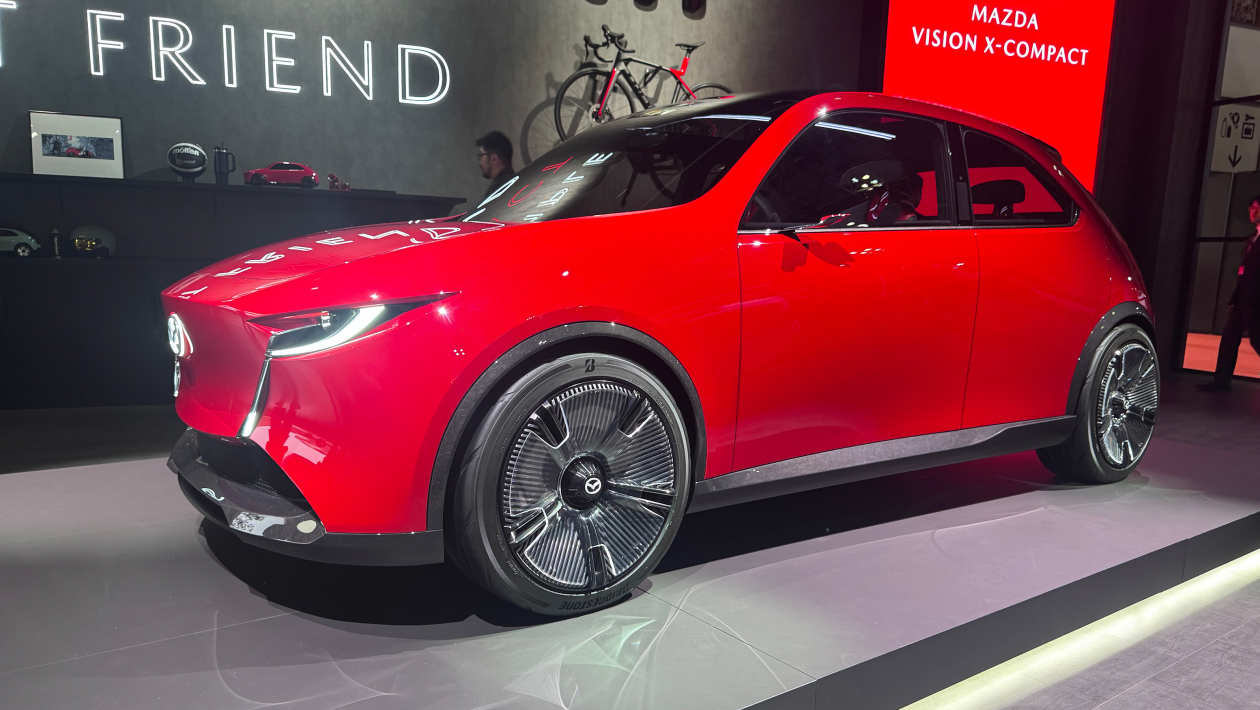
While this sounds non-committal, the ‘cross’ element of the X-Compact’s name could refer to the fact that while it will be a B-segment hatchback, it could also have a slightly higher ride height, in effect replacing both the Mazda 2 supermini and previous CX-3 in one model. Mazda has confirmed that a new small B-segment SUV for Asian markets will be introduced in the next 24 months, but this is not that car.
Mazda won’t confirm when the newcomer will be ready for mass production, but given that the current car has been on sale since 2014 and gone through two updates, we suspect the new version won’t be far away.
Get the latest and best car news and reviews, first! Follow Auto Express on Google today