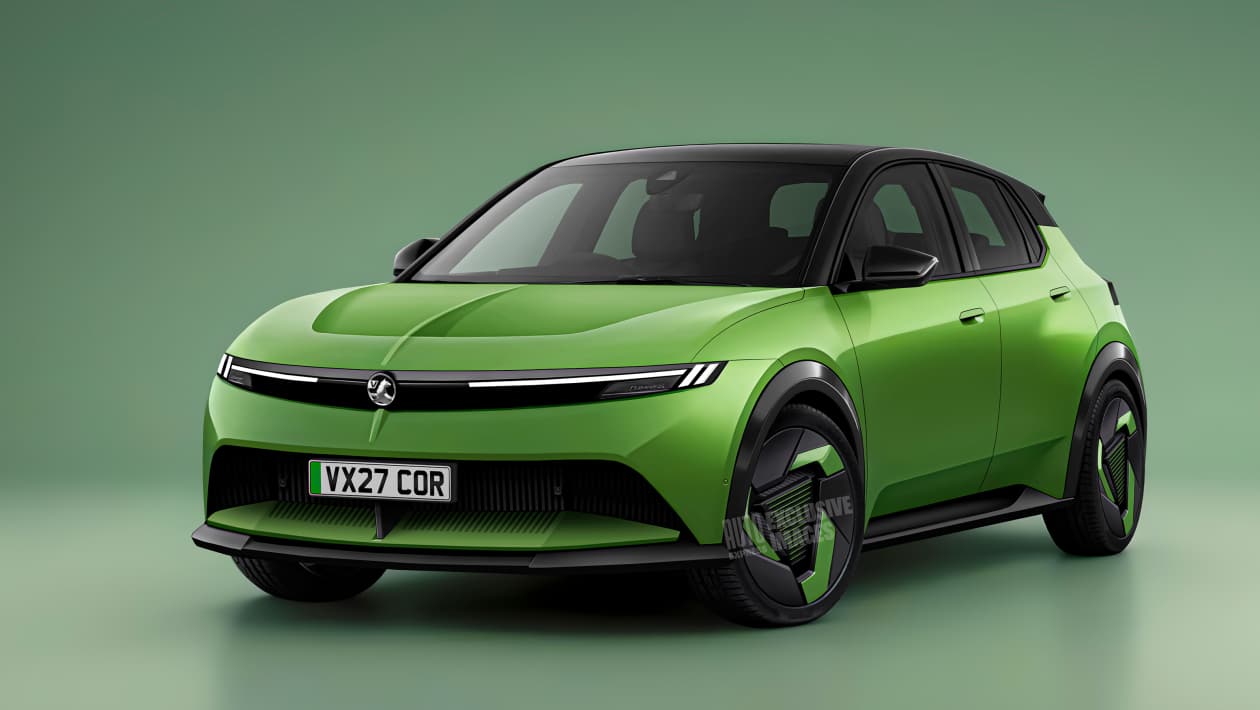
Vauxhall has done this by putting lighting elements at the centre of the vizor, rather than around its edges. This is enabled by the use of new compact LED lighting up front that’s more subtle and integrated than the current generation Corsa’s.
Like many current Vauxhalls, the roof will be available in a contrasting colour. However, this time, rather than using black or silver trim to split the colours, it’ll happen more organically on the C-pillar without any plastic trim. The production car will also feature four-doors, rather than the concept’s two.
The production car should also see a simplified version of the concept’s glazed rear end, with a more traditional tailgate and lighting. We do expect the full-width rear lighting, including another Compass motif, to survive alongside a more geometric and aggressive rear bumper.
Vauxhall is also rightly proud of the triangular rear wing, which it’s hoping to bring into production on the future Corsa GSE.
What will be the rivals and alternatives to the new Corsa?
By 2028 the supermini class will feature a range of fresh rivals that will make the new Corsa’s life quite difficult. The big one comes from Volkswagen, which has a new Polo-sized electric ID. Polo. Cupra’s closely-related Raval will precede it to market, and Skoda will have its own variant with the Epiq.
Looking at France, the aforementioned Peugeot E-208 will share many of its key elements with the Corsa, and then there’s the Renault 5, which is already massively popular. Hyundai and Kia will also have their supermini-sized EVs on track by then. Regardless of how good the new Corsa will be, the market will be much tougher than when the original Corsa-e arrived in 2019. However, what we know so far suggests that the model has never been better geared up to lead its class – a first for a Vauxhall supermini in a very long time.
Come and join our WhatsApp channel for the latest car news and reviews…